
Keycaps used to be treated like simple labels. They told you which key was A, Enter, or Shift, and that was enough. Today, they do more work. They affect feel, sound, color, desk style, and the way a keyboard shows personality before anyone starts typing.
That shift is the real evolution of keycaps: from standard utility parts to a mix of practical components, design objects, and collectible accents. A good keycap choice still has to fit the keyboard first. But once fit is solved, the choice becomes much more personal.
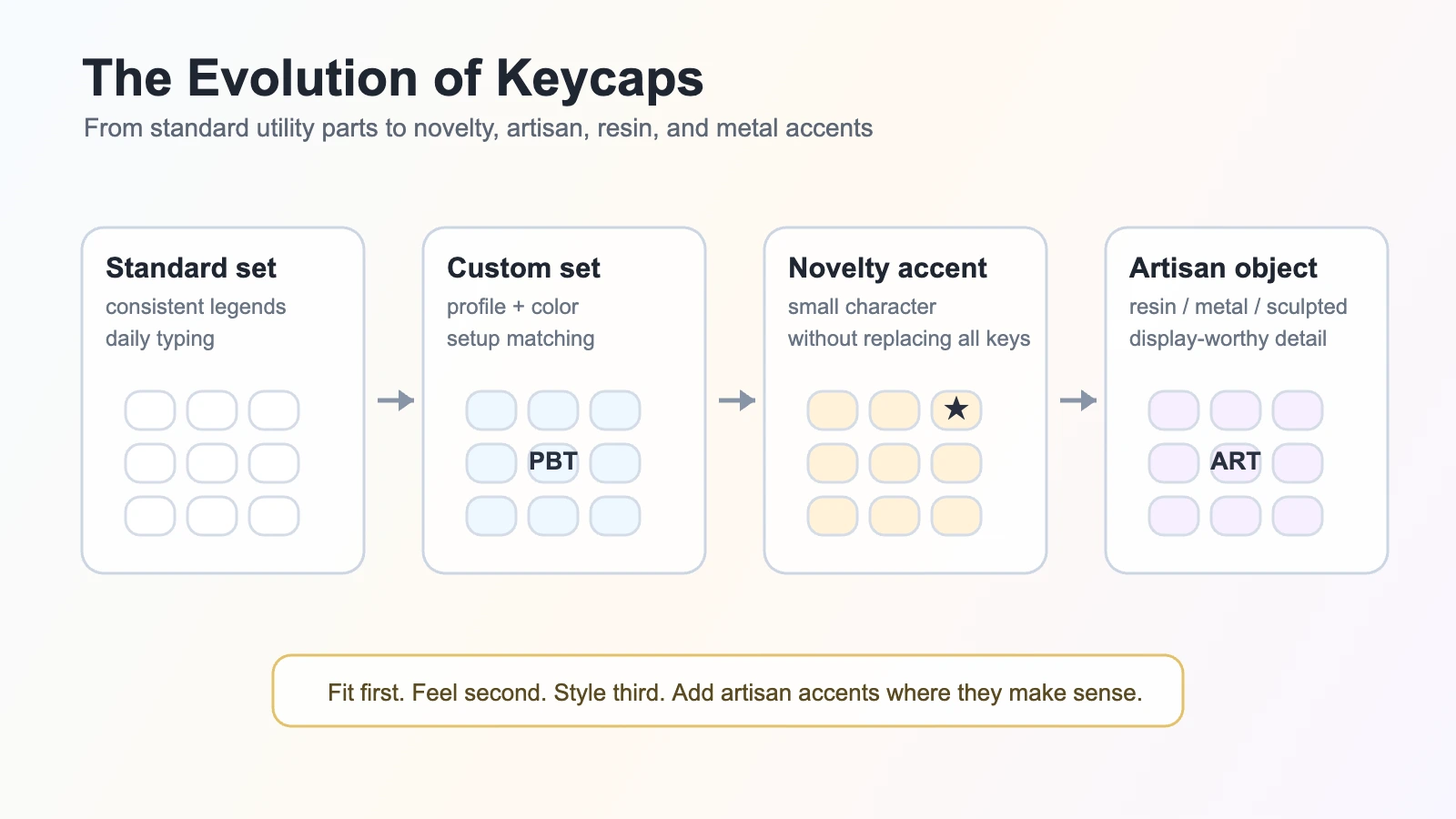
Standard Keycaps: The Practical Starting Point
Standard keycaps are designed to be predictable. They usually come in complete sets, use familiar legends, and focus on daily typing. For many keyboards, this is exactly what you want: a clean layout, consistent height, and keys that do not distract from work or gaming.
Most standard sets are made from ABS or PBT plastic. ABS often feels smooth and can be easier to mold in vivid colors, but it may develop shine with heavy use. PBT is usually more resistant to shine and has a slightly drier texture. The better choice depends on the feel you like, the finish you want, and how heavily you use the board.
Standard does not mean boring. A simple PBT set can make a keyboard feel calmer, cleaner, and more durable. It just solves a different problem from an artisan keycap.
Custom Sets Made Keyboards More Personal
The next step was the custom keycap set: colors, profiles, legends, and themes chosen to match a desk setup or a specific keyboard case. Instead of accepting the default factory look, keyboard owners began treating keycaps like part of the build.
This is where profile matters. Cherry, OEM, MOA, XDA, SA, and other profiles change the height and shape of the typing surface. A taller rounded profile can make a board feel playful and sculpted. A lower Cherry-style profile can feel more familiar and controlled. A uniform profile can make rearranging keys easier on unusual layouts.
For shoppers, the best custom set is not the loudest one. It is the one that fits the board, fits the hands, and supports the look you actually want on the desk.
Novelty Keycaps Added Small Points of Character
Novelty keycaps sit between standard sets and one-of-one artisan pieces. They may use playful legends, small icons, themed colors, or accent keys that change the mood of a keyboard without replacing the entire set.
That makes them useful for people who want personality but still need a practical keyboard. A novelty Escape key, Enter key, or small accent cluster can make a board feel special while the main typing area remains easy to use.
If you are browsing by theme, start with the broader Novelty Keycaps collection or the keycap set category. The goal is not just to find a design you like; it is to find a design that still works with your layout and switch type.
Artisan Keycaps Turned Keycaps Into Objects
Artisan keycaps changed the scale of the hobby. Instead of thinking only in full sets, people began using individual keys as tiny sculptures. Resin, metal, translucent layers, hand-painted details, and cast shapes can make one key stand out like a small object on the keyboard.
That does not mean every artisan keycap is meant for every key. Many artisan pieces are best used on Escape, Enter, function row keys, or a display spot where they will not interrupt fast typing. A tall sculpted key may look wonderful but feel awkward in the middle of a gaming cluster.
This is why artisan buying is a little different from buying a full set. You are not only asking “does it fit?” You are also asking “where will this key live?” and “will it be comfortable there?”
Materials Changed the Feel of Customization
Material is one reason modern keycaps feel so varied. PBT and ABS cover most standard sets, but novelty and artisan designs often expand into resin, aluminum, zinc alloy, wood-like finishes, translucent plastics, or mixed materials.
Each material brings tradeoffs. Resin can create depth, tiny scenes, and layered effects. Metal can feel cool and solid, but it adds weight and may not be ideal for every switch or typing position. PBT is durable for full sets. Transparent or translucent materials can work beautifully with RGB, but only if the design is meant to transmit or catch light.
For daily typing, start with comfort. For accent keys, you can give more weight to visual impact.
The Buying Question: Full Set or Accent Key?
A full keycap set changes the whole keyboard. It is best when your current board feels visually wrong, the legends are worn, or you want a consistent profile and color system. An accent key is better when you already like the main set but want one detail that makes the keyboard feel less generic.
| Choice | Best for | What to check |
|---|---|---|
| Standard full set | Daily typing, clean setups, replacing worn keys | Layout coverage, material, profile |
| Novelty set | Themed desk setups and playful keyboards | Compatibility, legends, color balance |
| Artisan accent key | One focal point or collectible detail | Stem support, height, placement, weight |
| Metal or resin key | Display spots, Escape keys, special accents | Comfort, switch feel, clearance |
Products such as a resin Shiba Inu artisan keycap, a CNC aluminum heart keycap, or a soft full set like Strawberry Milk Rabbit PBT keycaps all serve different roles. Treat them as different tools, not interchangeable decorations.
What Modern Keycap Trends Are Really About
It is easy to describe keycap trends as “more color” or “more themes,” but the deeper trend is control. Keyboard owners want to control how the board sounds, how it feels, how it photographs, and how it fits into a room.
That is why the same person might use a quiet PBT set for work, a playful novelty set for a home setup, and one artisan key as a collectible accent. The keyboard is still a tool. It just no longer has to look anonymous.
A Simple Way to Choose
If you are new to custom keycaps, choose in this order:
- Fit first: confirm switch stem, layout, profile, and key sizes.
- Feel second: decide whether you prefer smooth, textured, tall, low, light, or solid keys.
- Style third: pick colors and themes that match the keyboard and desk.
- Accent last: add artisan or novelty keys where they will not hurt daily use.
The evolution of keycaps did not replace standard keycaps. It gave keyboard owners more choices. Standard sets, novelty themes, artisan accents, resin pieces, and metal keys all belong in the same world when they are chosen for the right job.